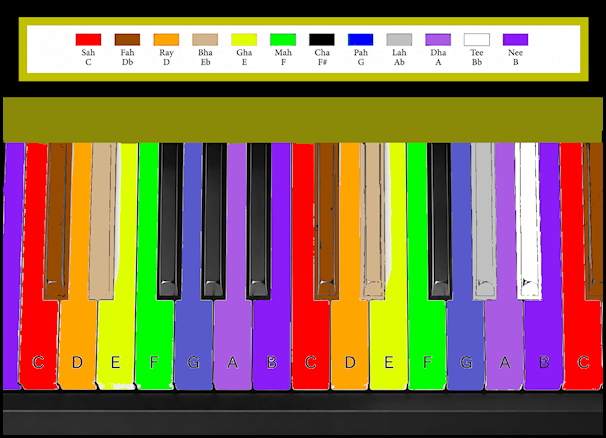


Twelve Sacred Notes
Sah - C - Red
- the Root
- Human and Sacred
- Ground and Sky
- Divine Unity...
- God, the One
Fah - Db (C#) - Brown
- Tender
- Shy
- Sad
- Lovely
- Peaceful Divine Playfulness...
- God, of whom we are Mindful
Ray - D - Orange
- Vital
- Confident
- Commanding
- Honest Divine Power...
- God, the All-Powerful
Bha - Eb (D#) - Tan
- Sustenance
- Resignation
- Wonder
- Surrender Divine Abundance...
- God, who Provides
Gha - E - Yellow
- Calm
- Serene
- Contented
- Compassionate
- Grateful Divine Joy...
- God, our Joy
Mah - F - Green
- Feminine
- Moonlight
- Passive
- Romantic
- Creative Divine Creativity...
- God, the Creator
Cha - F# (Gg) - Black
- Intensity
- Friction
- Suspense
- Surprise Divine Mystery...
- God, our Teacher
Pah - G - Blue
- Masculine
- Sunlight
- Active
- Fullness
- Clarity Divine Wisdom...
- God, our Protector
Lah - Ab (G#) - Gray
- Expectation
- Appealing
- Arousing
- Entrancing Divine Promise...
- God, on whom we Await
Dha - A - Indigo
- Heroic
- Noble
- Restless
- Playful
- Brilliant Divine Fulfillment...
- God, who Fulfills
Tee - Bb (A#) - White
- Beauty
- Hope
- Delicate
- Affectionate
- Purity Divine Ecstasy...
- God, our Love
Nee - B - Violet
- Bold
- Sensuous
- Childlike
- Pleasurable
- Desirous Divine Motivation...
- God, our only Desire
Sah - C - Red (Octave)
- Completeness
- Resolution
- Freedom
- Spiritual Bliss Divine Unity...
- God, the One
Modified from the poem 'Twelve' from the Poetry collection Healing Love by Ron Bracale.
Many thanks to The Ragas of Northern Indian Music by Alain Danielou where the moods (Rasa) are associated with the notes and specific Ragas; and which has left me thinking endlessly about these relationships. Additionally he proposes that each note could be 1/8, 2/8, or 3/8 shades of a half tone sharp or flat. This is an attempt to understand pure tone Just Intonation which is the nature of the original Ragas with a Drone (a 6/5 bright m3 and a 7/6 blue m3 would both be 'Bha').
These are my own interpretations and the Note Sounds are presented phonetically. The Raga system only names the seven notes (Sa, Ra, Ga, Ma, Pa, Dha, Ni). The use of twelve note names is much richer.
These Twelve Note Sounds are based on interval pitch and transposing (using a Drone D note as 'Sa' root or tuning the drone to to 432) does not change the note name sound. Playing a 'piece', song, or Raga from a different root pitch will change the feeling in some ways and yet most of the feeling and expression will remain because intervals are primary to human hearing. Think of a singer using a capo on a guitar and the song's intended feeling comes through: so in that sense the moods and emotional expression of the notes is mostly correlated to pitch intervals. The placement of notes in sequence also alters the mood or emotional impact of specific notes to some degree: This reflects our lives where events feel different in different contexts and at different periods in our life experiences.
There is a Raga tradition of singing the note names and I hope some singers will embrace this twelve name system.
Music is about conveying feeling and emotion! This is a foundation for conscious composing, but feeling and emotion are complex and numinous, so the musician but conveys the essence that translation from sound to the inner experience of the listener is the essential communication. Music touches a deep essence in our beings which is much more direct than words will ever convey.
Many thanks to The Ragas of Northern Indian Music by Alain Danielou where the moods (Rasa) are associated with the notes and specific Ragas; and which has left me thinking endlessly about these relationships. Additionally he proposes that each note could be 1/8, 2/8, or 3/8 shades of a half tone sharp or flat. This is an attempt to understand pure tone Just Intonation which is the nature of the original Ragas with a Drone (a 6/5 bright m3 and a 7/6 blue m3 would both be 'Bha').
These are my own interpretations and the Note Sounds are presented phonetically. The Raga system only names the seven notes (Sa, Ra, Ga, Ma, Pa, Dha, Ni). The use of twelve note names is much richer.
These Twelve Note Sounds are based on interval pitch and transposing (using a Drone D note as 'Sa' root or tuning the drone to to 432) does not change the note name sound. Playing a 'piece', song, or Raga from a different root pitch will change the feeling in some ways and yet most of the feeling and expression will remain because intervals are primary to human hearing. Think of a singer using a capo on a guitar and the song's intended feeling comes through: so in that sense the moods and emotional expression of the notes is mostly correlated to pitch intervals. The placement of notes in sequence also alters the mood or emotional impact of specific notes to some degree: This reflects our lives where events feel different in different contexts and at different periods in our life experiences.
There is a Raga tradition of singing the note names and I hope some singers will embrace this twelve name system.
Music is about conveying feeling and emotion! This is a foundation for conscious composing, but feeling and emotion are complex and numinous, so the musician but conveys the essence that translation from sound to the inner experience of the listener is the essential communication. Music touches a deep essence in our beings which is much more direct than words will ever convey.